PCO Licence: Requirements, Costs and How to Apply
20 Dec 2024 • 40 min read
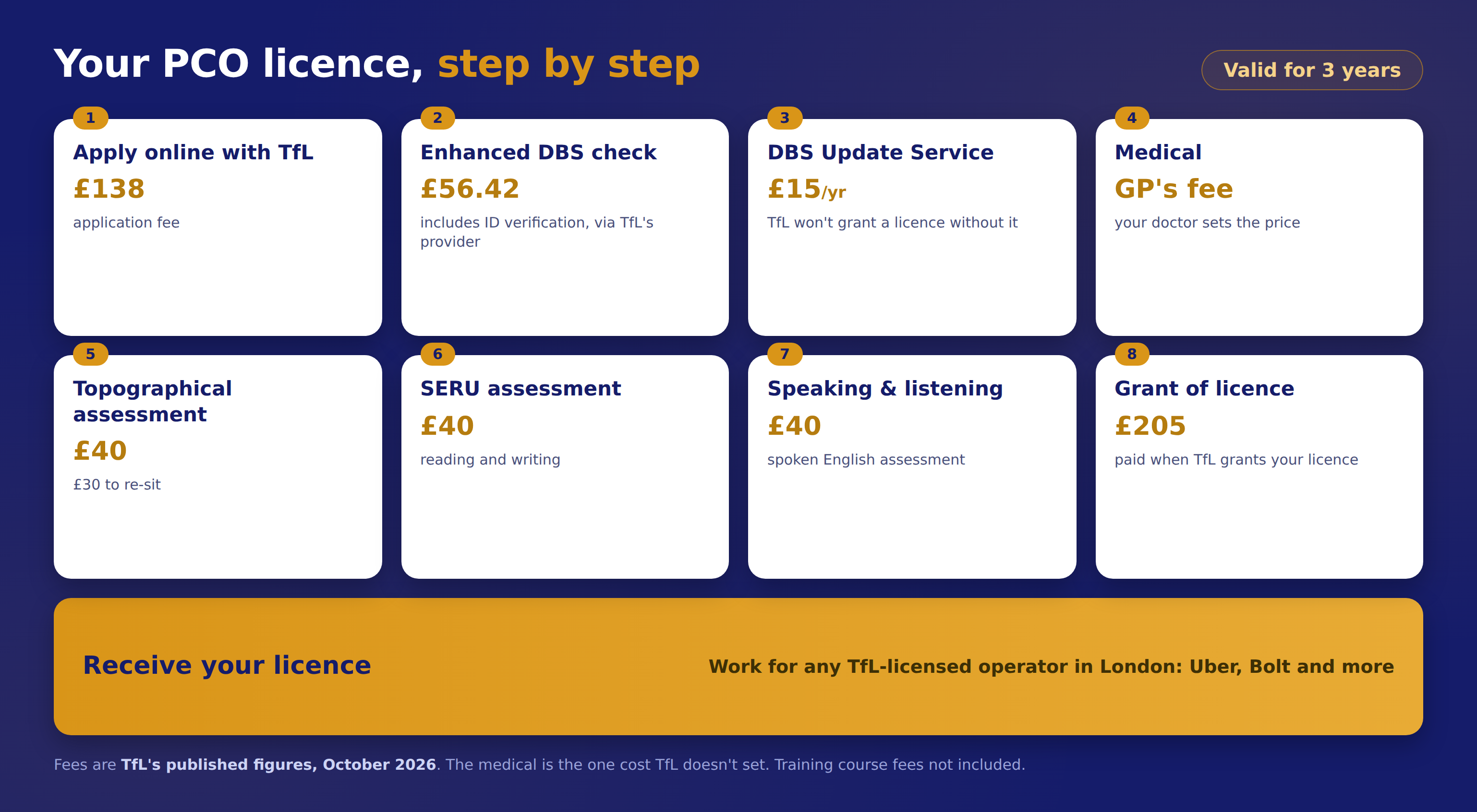
Anyone who wants to drive a private hire vehicle in London, whether for Uber, Bolt or a minicab firm, needs a PCO licence. TfL issues it, it lasts three years, and getting one means clearing a fixed set of checks: age, driving experience, right to work, a criminal records check, a medical, and three assessments. This guide walks through each requirement, what the process involves, and what it costs, using TfL's published fees as of October 2026. If you would rather have someone handle the paperwork, our PCO licence application service covers the whole process.
What is a PCO licence?
PCO stands for Public Carriage Office, the part of Transport for London that licenses taxis and private hire vehicles. The licence itself is a private hire driver licence, but almost everyone in the trade calls it a PCO licence. It allows you to carry passengers in London for any operator licensed by TfL, and once you hold one you can switch between operators without reapplying.
The licence is valid for three years. Renewal is treated as a fresh application, so the checks (a new DBS check, the SERU and English assessments, a medical if you are over 45 and your last one was more than three years ago, and an HMRC tax check) repeat each cycle. There is no upper age limit as long as you keep meeting the requirements.
PCO licence requirements
TfL publishes the eligibility criteria on its licensing pages. You must:
- be at least 21 years old when you apply
- hold a full DVLA, Northern Ireland or EEA driving licence that you have held for at least three years (time spent on a licence exchanged from a designated country does not count towards the three years)
- have the right to live and work in the UK
- be of good character, proven with an enhanced criminal records check run through TfL's authorised provider
- meet the DVLA Group 2 medical standards, which in most cases means a medical examination with a doctor who has access to your full medical history
- pass a topographical skills assessment at a TfL driver assessment centre
- pass two further assessments: a speaking and listening assessment, and the SERU assessment, which tests your reading and writing
Two extra rules catch people out. First, if you have lived outside the UK for a continuous period of three months or more at any point in the last 10 years, TfL asks for a Certificate of Good Conduct from that country. Second, all applicants must register with the DBS Update Service before TfL will grant the licence, and keep the subscription going for as long as they hold it.
How to apply for a PCO licence, step by step
The application runs through TfL's online system, and most of the checks happen in parallel:
- Apply online. Start your application on tfl.gov.uk and pay the £138 application fee. Creating a TfL online account also lets you track your application's progress while it is being processed. First-time applicants also confirm they are aware of HMRC's guidance on paying tax on licensed trade income.
- Complete the enhanced DBS check. The check runs through TfL's authorised provider and includes ID verification. Register with the DBS Update Service (£15 a year) at the same time; TfL will not grant a licence without it. Our DBS process guide covers this step in detail.
- Get your medical done. Your GP (or another doctor with access to your medical records) completes the medical against the DVLA Group 2 standards. The doctor sets the fee. More on this in our TfL medical guide.
- Pass the topographical assessment. A map-reading and route-planning test taken at a TfL driver assessment centre. It costs £40 to take (£30 to re-sit). We run topographical training sessions at our centre at 1a Brayford Square, E1 if you want to walk in prepared.
- Pass the SERU and English assessments. The SERU assessment covers reading and writing; the speaking and listening assessment covers, as the name suggests, spoken English. Each costs £40. See our SERU assessment guide for what to expect.
- Wait for the grant. Once every check clears, TfL issues the licence and takes the £205 grant fee.
The DBS check, the medical and the assessments can all run at the same time, so the order above is about what makes sense, not what TfL requires. The slow stages are usually DBS verification and assessment-centre waiting times, so booking your assessments early is the single best way to shorten the total.
How much does a PCO licence cost?
TfL's published fees (as of October 2026) break down like this:
- Licence application fee: £138
- Grant of licence fee: £205
- Enhanced DBS check (includes ID verification): £56.42
- DBS Update Service: £15 a year
- Topographical assessment: £40 (£30 to re-sit)
- SERU assessment: £40
- Speaking and listening assessment: £40
- Medical: set by your doctor
TfL's fixed fees come to £519.42: the £138 application, the £56.42 DBS check, three assessments at £40 each, and the £205 grant. Adding the first year of the DBS Update Service (£15) and the Post Office Check and Send service (£7.15) brings the total to about £542, before your GP's medical fee. The medical is the one cost TfL does not set: your doctor charges their own fee for it.
How long does it take?
TfL does not publish a fixed processing time; its current guidance says only that it aims to process new applications within a reasonable period and points applicants to its licensing service updates. What we see at the centre is that the total depends almost entirely on how quickly the individual checks clear: the DBS verification, the medical appointment, and assessment-centre availability. Applicants who book their assessments early and keep their documents consistent (TfL requires your names to match across all identity documents) move through noticeably faster than those who leave the bookings until after they apply.
Renewing a PCO licence
Renewal works as a fresh application: a new DBS check, the SERU and speaking and listening assessments, a medical if you are over 45 and your last one was more than three years ago, and an HMRC tax check. The tax check produces a 9-character code that is valid for 120 days, so time it close to your renewal submission. Letting a licence lapse is not a paperwork problem; driving private hire without a valid licence is a criminal offence, so start the renewal well before the three years are up.
PCO licence FAQs
Can I drive for Uber or Bolt with a PCO licence?
Yes. The licence is issued by TfL, not by any operator, so once you hold it you can work for any private hire operator licensed in London, including Uber, Bolt and local minicab firms.
How long is a PCO licence valid?
Three years. Renewal requires a fresh application with a new DBS check, a medical if you are over 45 and your last one was more than three years ago, and an HMRC tax check code.
Do I need the English test for a PCO licence?
Applicants must pass two assessments that together cover English: the SERU assessment, which tests reading and writing, and a separate speaking and listening assessment. The requirement applies to new applications and renewals alike.
What is the SERU assessment?
SERU stands for Safety, Equality and Regulatory Understanding. It is a TfL assessment that tests reading and writing skills alongside your knowledge of the regulations that apply to private hire work.
How much does the whole PCO licence process cost?
TfL's own fees add up to £519.42, plus the medical (set by your GP), the DBS Update Service subscription (£15 a year) and any training or preparation you choose to do.